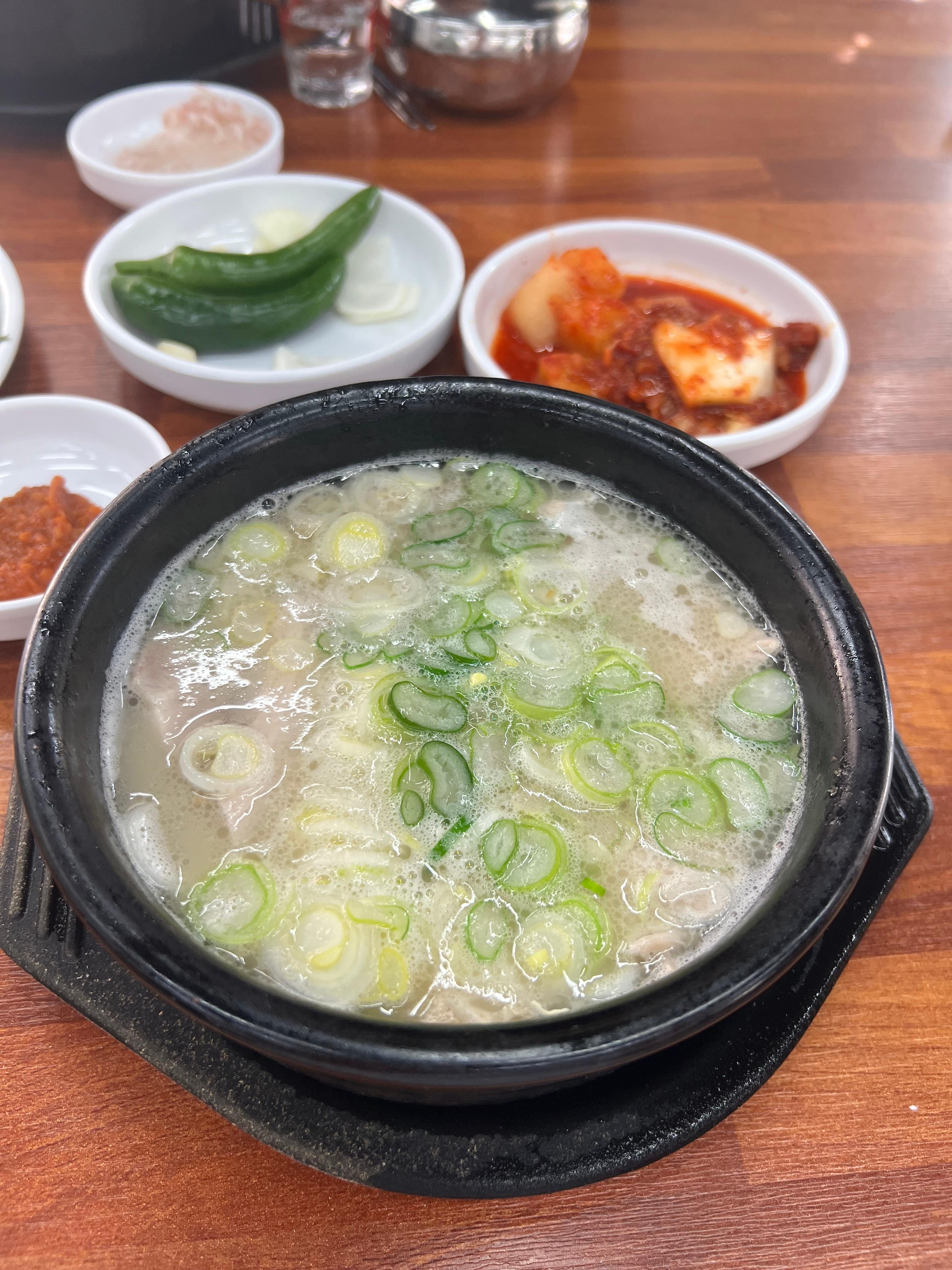
Dwaeji Gukbap (Pork Soup) is a local dish representing Busan and the Gyeongsang province. It is a meal that combines hot broth, generous portions of meat, and the joys and sorrows of the common people into a single bowl. To the people of Busan, Dwaeji Gukbap is more than just a meal; it is a taste of home, a comfort food, and one of the dishes most missed by those from Busan living elsewhere.
1. History and Origins
1.1 The Miryang Origin Theory (1938)
While there are several theories regarding the origin of Dwaeji Gukbap, the oldest records can be found in Muan-myeon, Miryang. Miryang’s Dwaeji Gukbap began at the Muan Market in 1938 and has maintained its tradition for nearly a hundred years. This is a significant fact proving that Dwaeji Gukbap existed even before the Korean War (1950-1953).
The background for Miryang becoming the birthplace of Dwaeji Gukbap lies in the region's economic characteristics. During the Japanese colonial period, Miryang flourished as a center of transportation and commerce after the Gyeongbu Railway Line was laid in 1905 and Samlangjin Station, the starting point of the Gyeongjeon Line connecting Jeolla and Gyeongsang provinces, was established. With many people gathering and economic activity bustling, the conditions were ripe for the formation of a dining-out market.
1.2 The Busan Refugee Theory (Korean War)
The most widely known theory connects the origin of Busan Dwaeji Gukbap to the history of the Korean War and refugees. According to the Encyclopedia of Busan Culture, when the Korean War broke out in the 1950s, countless refugees settled in Busan. Struggling to make a living, these refugees began making soup using pork by-products as they searched for cheap yet nutritious ingredients.
In Busan’s Seomyeon Market, there is a Dwaeji Gukbap restaurant started by Ms. Kim Young-sun in 1954, showing that the dish began to properly take root in Busan right after the war. Additionally, ‘Hadong House’ (now closed) in Beomil-dong, Busanjin-gu, which opened in 1952, is often cited as the originator of Busan Dwaeji Gukbap. (Source: Busan Ilbo Dwaeji Gukbap Road)
2. Process of Development
2.1 1950-60s: The Settlement Period
Until the early 1960s, Dwaeji Gukbap was quite rare. Originally similar to North Korea's 'Gari Gukbap', it began to settle as a unique food of the Gyeongsang province as North Korean refugees settled in Busan. Supporting this is the fact that while Sundae Gukbap (Blood Sausage Soup) or Someori Gukbap (Ox Head Soup) are common in Seoul, Gyeonggi, and Chungcheong regions, Dwaeji Gukbap is rare there, whereas it became a common sight in Gyeongsang regions centered around Busan, Miryang, and Daegu. (Source: Encyclopedia of Korean Local Culture)
During this period, Dwaeji Gukbap established itself as a meal for commoners with light pockets, port laborers, and market merchants. Restaurants began to spring up around areas densely populated by the working class, such as Seomyeon, Beomil-dong, and Choryang-dong.
2.2 1970-80s: The Expansion Period
As refrigerators became common in the 1970s, taboos regarding pork began to disappear. By the 1990s, the taboo against using the name "pig" (Dwaeji) had completely vanished, and Dwaeji Gukbap began to appear in the Jeolla region as well.
A trace of the government-led mixed grain consumption movement in the 1960s and 70s can be seen in the practice of serving Somyeon (wheat noodles) in soup restaurants. In 1969, the government issued an administrative order mandating all restaurants to mix at least 25% barley or wheat flour in their food, which led soup restaurants to serve Somyeon with their soup. Somyeon was also a way for commoners with light wallets to fill their stomachs at these restaurants. (Source: Busan Ilbo Dwaeji Gukbap Road)
2.3 Late 1990s-2000s: Popularization and Tourism
Paradoxically, the 1997 IMF financial crisis brought about the popularization of Dwaeji Gukbap. Requiring little capital or specialized technology, Dwaeji Gukbap became a popular startup item for the unemployed, and the Busan Ilbo was filled with news of new Dwaeji Gukbap restaurant openings during this time. Many restaurants remember the IMF era as a boom period; for construction workers, market merchants, and commoners struggling financially, Dwaeji Gukbap was a grateful meal. (Source: Busan Ilbo Dwaeji Gukbap Road)
In the 2000s, with the opening of the KTX, Dwaeji Gukbap began to emerge as a tourist food. Bonjeon Dwaeji Gukbap, which moved to the alley next to Busan Station in 2002, became a famous spot where out-of-town visitors would line up with their suitcases every weekend. Similarly, Hapcheon Ilryu Dwaeji Gukbap became famous among business travelers from Seoul as the KTX began stopping at Gupo Station.
The Busan International Film Festival (BIFF) also contributed to guiding the younger generation nationwide into the world of Dwaeji Gukbap. Sibling Traditional Dwaeji Gukbap, which opened in Haeundae Market in 1972, became so popular with the youth that the autumn film festival period or winter breaks when university students visit Busan became busier than the summer season. (Source: Busan Ilbo Dwaeji Gukbap Road)
The generation enjoying Dwaeji Gukbap has also shifted. In the past, it was considered a "men's food," but now it is loved by men and women of all ages. Ssangdung-i (Twins) Dwaeji Gukbap, which opened in Daeyeon-dong in 1996, first captivated the tastes of university students with its clean taste and generous portions, and has now become a tourist attraction visited even by travelers from Southeast Asia.
3. Cooking Methods
3.1 Making Broth
The core of Dwaeji Gukbap is the broth. Ingredients for the broth are largely divided into bones and meat; usually, boiling bones for a long time produces a milky broth, while boiling meat produces a clear broth. The color and density of the broth vary depending on the ratio of bones to meat, the order they are added, and the boiling time at each restaurant.
Leg bones (femur, knee bone, shin bone), often called sagol, are mainly used. Some restaurants mainly use the spine or mix four different parts of bones.
The process of making broth is as follows:
- First Boil (Removing Blood): Put pork bones and meat in cold water and boil for about 10 minutes, then discard the water. It is important to remove the blood from deep inside. Adding bay leaves and whole peppercorns helps remove odors.
- Washing Clean: Wash each bone thoroughly. This process is key to making a clean broth.
- Main Boiling: Put the cleaned bones back into the pot, pour in plenty of water, and boil hard for over an hour. Using rice water can create a deeper flavor. Add broth ingredients such as onions, garlic, green onions, and chives (white part).
- Long Simmering: For a rich broth, it must be boiled for at least 6-8 hours, and specialty shops may boil it for over 12 hours. During this process, it is important to continuously skim off impurities and remove fat.
3.2 Preparing Meat
The meat used in Dwaeji Gukbap is mainly front leg meat or neck meat. The meat is prepared by boiling it with the broth or boiling it separately. Traditional restaurants in Muan-myeon, Miryang, are known to wash lean pork that has almost no fat with salt and flour. (Source: Gyeongnam Domin Ilbo)
Some restaurants use head meat. A regular spot in Miryang Traditional Market has been using head meat since before 1950, and many regulars visit specifically for the chewy texture of the head meat. Although preparing head meat requires a lot of effort, some restaurants still insist on it for this taste. (Source: Visit Korea)
After boiling thoroughly, the meat is sliced. It is either sliced thinly to about 0.3cm or thickly depending on the restaurant. Miryang style typically features thinly sliced meat, while Busan style often includes relatively thick slices.
3.3 Torryeom (Pouring) Method
The most important process in the traditional Dwaeji Gukbap cooking method is ‘Torryeom’. Torryeom refers to the method of repeatedly pouring hot broth over rice and meat and then draining it to bring the dish to the appropriate temperature.
Old Dwaeji Gukbap establishments in Busan unanimously agree that Torryeom is the optimal cooking method for taste. While pouring hot broth over cooled rice and sliced meat 10 to 20 times, the temperature of the soup reaches around 80°C. According to Professor Moon Sook-hee of the Department of Food and Nutrition at Kyungnam College of Information & Technology, extremely hot liquid food makes it difficult to taste saltiness properly, leading to over-seasoning, but adjusting to the right temperature through Torryeom allows for appropriate seasoning control. (Source: Busan Ilbo Dwaeji Gukbap Road)
However, recently, with the development of insulated rice warmers and heating cabinets, more restaurants are serving broth poured directly without Torryeom. This is also due to an increasing number of people who view the repeated pouring of broth into the communal pot as unhygienic or suspect that leftover rice is being reused.
3.4 Seasoned Paste (Dadaegi)
Dadaegi (seasoned red pepper paste) is an important seasoning that determines the taste of Dwaeji Gukbap. The basic recipe is as follows:
- Red pepper powder: 2-3 spoons
- Minced garlic: 1/2-1 spoon
- Minced cheongyang chili pepper: 1/2 spoon (optional)
- Black pepper: 1/2 teaspoon
- Perilla seed powder: 1 spoon (optional)
- Soy sauce: 1 spoon (optional)
- Adjust consistency with soup broth or water
While some restaurants serve the soup with dadaegi already added in the kitchen, the trend is shifting towards providing separate seasoning containers so customers can add it to their liking. Out of 30 restaurants on the Busan Dwaeji Gukbap Road, 10 allow diners to add the seasoning themselves.
4. Taste Characteristics
4.1 Difference from Seolleongtang
Unlike Seolleongtang (Ox Bone Soup), which uses beef, Dwaeji Gukbap is characterized by the intense, unique scent of pork broth. If Seolleongtang feels clean and refined, Dwaeji Gukbap has a much stronger smell of boiled meat and can be considered a "wilder" food.
Dwaeji Gukbap is not only a matter of like or dislike, but individual preferences also vary greatly. Hapcheon-style soup is clear with thick meat offering a good texture, whereas Busan-style features a rich, milky broth. Daegu-style is characterized by the relative abundant use of spices and innards.
4.2 Nutritional Value
One bowl of Dwaeji Gukbap contains about 480 kcal, and including the side dishes, a single meal is approximately 500 kcal. While the calorie count is not high, it is a healthy meal that possesses all the basic food groups: protein from the meat, calcium from the broth, carbohydrates from the rice, and vitamins and minerals from the side dishes. (Source: Encyclopedia of Korean Local Culture)
It is a delicacy especially when eating rice in hot soup during winter. As a representative high-value-for-money food, adding chives and salted shrimp (saeu-jeot) to Dwaeji Gukbap allows you to experience an even richer flavor.
References and Sources
- Encyclopedia of Busan Culture (busan.grandculture.net) - Item: Dwaeji Gukbap
- Busan Ilbo (2019) - Busan Dwaeji Gukbap Road Special Series
- Encyclopedia of Korean Local Culture (ncms.nculture.org) - Soup made in refuge, Dwaeji Gukbap
- Wikipedia - Item: Dwaeji Gukbap
- Namuwiki - Item: Dwaeji Gukbap
- Gyeongnam Domin Ilbo (2021.04.05) - Clear and light Dwaeji Gukbap with 100 years of history
- Visit Korea (Korea Tourism Organization) (korean.visitkorea.or.kr) - A warm bowl of soup that offers comfort, Miryang Dwaeji Gukbap
- Dangdang News (2022.06.14) - Miryang's Dwaeji Gukbap and Busan's Dwaeji Gukbap
- OhmyNews (2009.01.09) - Do you know where the original Dwaeji Gukbap is?
- National Institute of Agricultural Sciences, Rural Development Administration - Korean Traditional Local Food Recipes
※ This post was written by synthesizing information from the above sources, and reliability was secured by cross-verifying the contents of each source.